

Arabic Perfume for Men vs Women vs Unisex: Which Should You Choose?
A guide to navigating one of the world's most storied fragrance traditions, and finding the bottle that belongs on your dresser.
Arabic perfumery has quietly moved from a regional tradition to one of the most influential currents in contemporary fragrance. What was once described in Western magazines as "exotic" (oud, attar, mukhallat) now sits on the shelves of the most respected niche houses from Paris to London. Today, I want to talk about how to navigate this world if you're new to it, and specifically how to decide between an Arabic perfume designed for men, for women, or one of the increasingly popular unisex compositions.
The gender labels in this category are less rigid than they appear. A men's oud can read beautifully on a woman; a women's rose blend can feel astonishingly masculine on the right skin. Still, the categories exist for a reason, and choosing well depends on understanding what each one is built to do. Consider what follows your starting compass.
What Makes Arabic Perfume Special?

To understand what sets Arabic perfumery apart, you have to understand what it has refused to compromise on. Centuries before Western perfumery was industrialized, the perfumers of the Arabian Peninsula were already working with concentrated oils (attars, mukhallats, and dehn al oud) pressed from raw materials whose value was measured by the gram.
This heritage shows itself in three ways that I find consistently distinguish an Arabic perfume from a typical European eau de toilette.
The Ingredients
First, the ingredients. Real oud oil, depending on origin and grade, ranks among the most expensive raw materials in perfumery, often more costly per gram than gold of the same weight. Taif rose absolute, natural saffron, ambergris, sandalwood: these are not affordable supporting players. They are the spine of the composition, and they refuse to be diluted.
The Concentration
Second, the concentration. Most Arabic perfumes are formulated at extrait or eau de parfum strength, often with oil-rich bases that cling to skin and fabric for the better part of a day, sometimes longer.
The Architecture
Third, the architecture. Where French perfumery often aims for transparency and air, Arabic compositions tend to favor density, warmth, and a slow unfolding. The fragrance reveals itself in layers, sometimes over hours.
Arabic Perfume for Men
If there is a signature to the masculine side of Arabic perfumery, it lives in the base notes. Oud, smoky and resinous; musk, animalic and warm; amber, sweet but never sugary; leather, with its dry, almost smoldering presence; and a spice rack of cardamom, saffron, cinnamon, and black pepper. These are the materials that shape the genre. They lend a fragrance presence (what perfumers call projection) and a long, deep dry-down that is unmistakably Middle Eastern in DNA.
Scent Profiles
Three scent profiles tend to dominate. The smoky oud, where the wood is left almost bare and allowed to lead. The spicy oriental, where saffron and cardamom add fire to a woody base. And the modern fougère with a Middle Eastern twist: lavender and citrus on top, oud and amber underneath. The latter has become particularly popular among younger wearers who want the longevity of Arabic perfumery without the full traditional weight.
When to Wear
Honestly, these fragrances belong to any moment where presence matters. Evening events and weddings are obvious territory, but a well-built oud also works in winter offices, dinners, and any cold-weather setting where a softer Western scent would simply disappear.
Our Top Picks for Men
Three picks from our collection that, to my nose, represent the spectrum of contemporary Arabic perfumery for men:
|
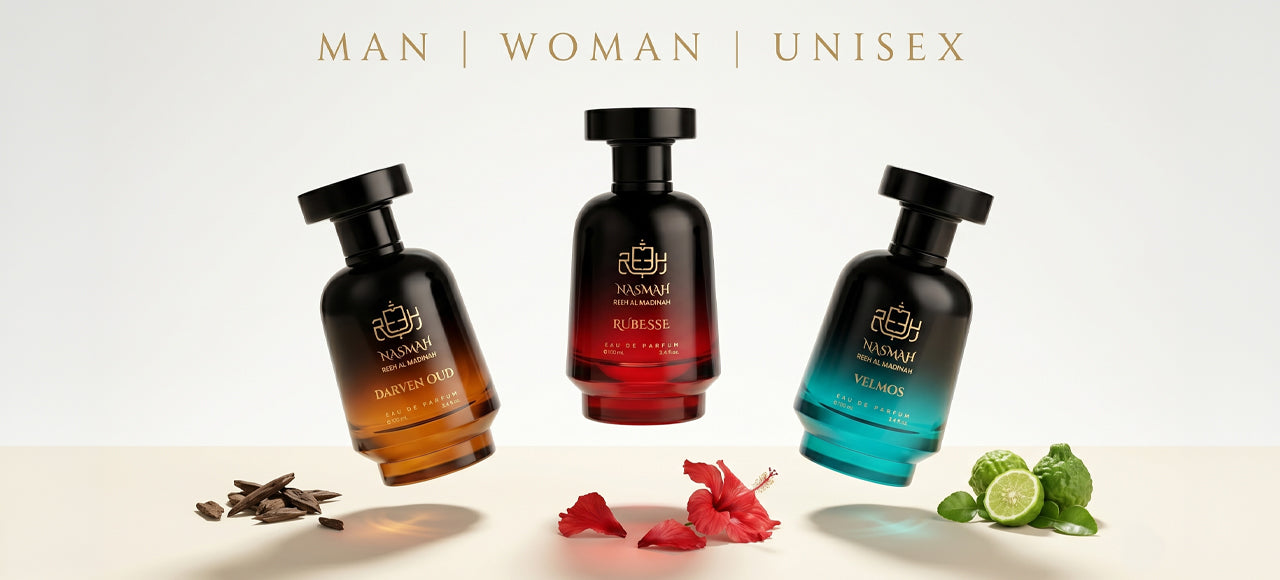
Nasmah Velmos — the modern fougère of the range. Bergamot and tangerine open with a brightness that softens into ginger and lavender, before settling into patchouli and oakmoss. It reads like a sun-dappled forest at first light: sophisticated, lively, and easier to wear in daytime than most oud-heavy compositions. |

£60
Buy Now
|
|
Royal Oud — closer to the traditional Gulf signature. Saffron and bergamot give way to a heart of oud, cardamom, and rose, and finally to sandalwood, musk, and vanilla. This is the one for evening wear and special occasions, with the smoky warmth I associate with the very best of the Arabian oud genre. |

£50£35
Buy Now
|
|
Real Men Intense — a marine-fresh top that drops into a base of oud, sandalwood, and amber. Grapefruit and lemon open the composition, but the dry-down is unmistakably oriental. A confident, modern bridge between Western and Arabic styles. |

£50£40
Buy Now
|
Price range for serious men's Arabic perfume tends to sit between £35 and £80 for a full bottle. Royal Oud and Real Men Intense are currently on offer, both well below the usual entry point for fragrances of this concentration.
Arabic Perfume for Women
Where the men's category is built on smoke and wood, the feminine side of Arabic perfumery leans into florals, but not the airy, transparent florals of contemporary French perfumery. Arabic rose is Taif or Damascena at full concentration: jammy, slightly honeyed, sometimes faintly metallic. Jasmine carries a creamy, indolic richness. Saffron, often classed as a spice in the West, takes on an almost leathery, suede-like quality in these compositions. And vanilla, far from the cupcake register, behaves as a balm that holds the whole structure together.
Scent Profiles
Three profiles dominate. The floral oud, where rose is paired with smoky wood for an effect that feels both regal and intimate. The floral fruity, where berries, citrus, or stone fruits brighten a heart of white flowers and a soft base of musk and vanilla. And the gourmand floral, where vanilla, amber, and sometimes honey add a creamy, edible warmth, without ever tipping into the dessert-perfume genre that has dominated Western mass-market gourmands.
When to Wear
The occasions span more than you might assume. The lighter fruity florals work for everyday wear, brunch, daytime offices. The deeper floral ouds and gourmand florals are made for evenings, dinners, weddings, and the kind of occasions where you want a trail (what perfumers call sillage) that announces itself a half-step before you do.
Our Top Picks for Women
Three picks from our women's range:
|
Nasmah Rubesse — the floral fruity of the collection. Blackcurrant and mint open with a tart, almost mischievous brightness, melting into hibiscus and rose, and resolving into a creamy vanilla and musk base. It reads as joyful and very wearable, equally at home in the daytime and at a romantic evening. |

£65
Buy Now
|
|
Forever — the gentlest of the three. Apple, vanilla, and citrus on top, jasmine and rose at the heart, and a warm base of vanilla, amber, and musk. The kind of fragrance one can imagine wearing on bare skin in summer, when something soft and undemanding is called for. |

£60£45
Buy Now
|
|
Beauty Intense — the most luminous of the trio. Orange and grapefruit at the opening, mimosa and jasmine through the heart, and a base of musk, sandalwood, and amber. Crisp but sensual, with a feminine transparency that carries from morning into evening events. |

£50£45
Buy Now
|
Women's Arabic perfumes typically sit between £45 and £90, with our trio currently between £45 and £65.
Unisex Arabic Perfume
It's worth noting that the entire concept of masculine and feminine perfumery is a relatively recent Western invention. In the Arabian tradition, fragrance was historically built around materials (oud, rose, amber, musk, ambergris) without strong gender coding. The recent rise of "unisex" perfume in the West is, in many ways, a return to that older sensibility. And it is happening fast.
What Makes a Perfume Unisex
What makes an Arabic perfume read as unisex usually comes down to balance. The composition is built on materials that are inherently universal (oud, sandalwood, cedar, musk, amber, luban or frankincense), and the perfumer takes care not to push too far in either a heavily floral or a heavily smoky direction. The result? A fragrance that adapts to the skin chemistry of whoever wears it, often in surprising ways.
Why the Category Is Growing
The category is growing for two reasons. First, a generation of younger wearers has become uninterested in being told what they should or shouldn't smell like. Second, couples are increasingly choosing to share one bottle. What was once a quirky habit is now a deliberate choice, and Arabic unisex perfumes, with their depth and longevity, are particularly well-suited to it. A single spritz on each wearer, and the same bottle takes two distinct paths.
Our Top Picks (Unisex)
Three picks from our unisex range:
|
Nasmah Darven Oud — the most refined of the three. Lemon and cardamom open with a crisp aromatic breath, easing into a heart of patchouli, lavender, and aromatic accords, before settling into amber, cedar, and a soft gourmand base. The desert breeze in fragrance form: bold but approachable. |

£65
Buy Now
|
|
Kalimat Intense — the most adventurous. Blueberry and basil at the opening is an unusual pairing, and one I rarely see executed well; here, it sets up a heart of honey and cedarwood, and a deep, lasting base of oud and amber. A composition that lingers without ever feeling heavy. |

£45£35
Buy Now
|
|
Oud Mood — the most traditionally rooted. Cambodian oud opens with a smoky warmth, balanced by rose and jasmine, with luban adding a meditative, almost ceremonial depth. For lovers of classic Gulf-style oud, this is the one. |

£55£45
Buy Now
|
Unisex Arabic perfumes generally range from £35 to £80. Our three currently sit between £35 and £65, particularly accessible entry points for the category.
Side-by-Side Comparison
Men's |
Women's |
Unisex |
|
Dominant Notes |
Oud, musk, amber, leather, spices |
Rose, jasmine, saffron, vanilla |
Oud, musk, amber, frankincense, cedar |
Scent Character |
Smoky, woody, spicy, deep |
Floral, fruity, creamy, warm |
Balanced, woody-floral, versatile |
Best Occasions |
Evenings, winter, formal events |
Daytime to evening, romantic occasions |
Anytime, adapts to wearer |
Longevity |
8 to 12+ hours |
6 to 10 hours |
8 to 10+ hours |
Best For |
Confident, traditional impression |
Feminine, elegant presence |
Couples sharing, modern wearers |
Starting Price |
£35 (Royal Oud) |
£45 (Forever, Beauty Intense) |
£35 (Kalimat Intense) |
What this table can't fully capture is that the categories overlap more than they separate. The longevity figures above are typical, not absolute. Skin chemistry, climate, and how you apply the fragrance all shift the result. Treat this comparison as a map, not a verdict, and let your nose make the final decision.
Which Should YOU Buy?
By Personality
If you gravitate toward confidence, presence, and a fragrance that announces itself before you walk into the room, the masculine oud genre is built for you. Royal Oud is a strong place to start. If you lean toward elegance, softness, and a fragrance that draws people closer rather than reaching across the room, the women's floral oriental category (Forever or Beauty Intense) will serve you well. And if you find the binary tiring, or if you are someone whose taste shifts with mood and season, the unisex compositions are designed for exactly that flexibility.
By Occasion
Daytime and warm weather call for the lighter end of the spectrum: Velmos, Forever, Beauty Intense, Darven Oud. Evenings, winter, and formal settings ask for the deeper compositions: Royal Oud, Rubesse, Oud Mood, Kalimat Intense.
By Budget
Under £40, Royal Oud and Kalimat Intense offer remarkable value for the concentration. Between £40 and £50, Real Men Intense, Forever, Beauty Intense, and Oud Mood sit in a comfortable middle range. Above £60, Velmos, Rubesse, and Darven Oud represent the most refined corners of the line, a strong starting point if you're looking for the best Arabian perfume to wear as a signature.
FAQ
Can a man wear a women's Arabic perfume?
Yes, and many do. Skin chemistry transforms a fragrance, and a rose-forward composition like Rubesse can read quite differently on warmer male skin. The Western convention of strict gender coding is not particularly observed in the Gulf, where wearers tend to select by note preference rather than label.
Are all oud perfumes unisex?
Not quite. Oud is genderless as a raw material, but how it's composed matters. Heavy smoky-leather ouds tend to read masculine; rose-oud and floral-oud compositions usually read feminine; balanced compositions like Oud Mood and Darven Oud sit comfortably in the unisex middle. When people ask me for the best oud perfume to start with, I usually point them toward this balanced category first.
What is the best Arabic perfume to give as a gift?
For a safer choice, opt for unisex. Nasmah Darven Oud and Oud Mood are universally well-received, and the Nasmah perfume line in particular makes an elegant gift presentation: the kind of bottle that holds its own on a dresser.
A Final Thought
There is no single right answer to the question of men's, women's, or unisex Arabic perfume. Only the one that fits the way you want to be remembered. What I can say with confidence is that the materials behind these fragrances (real oud, saffron, Taif rose, frankincense, sandalwood) reward the wearer who chooses thoughtfully. Move slowly. Study the composition. Let your nose decide.
The full Reeh Al Madinah collection, including the entire Nasmah line, is available now.


Leave a comment